2026 Safety Plan – Creating Structured Mental Health Support With Customizable Planning Tools
When you are navigating mental health challenges—whether for yourself, a client, or a loved one—having a structured way to document coping strategies, triggers, and action steps can make a meaningful difference. The 2026 Safety Plan is a digital template designed to help you build a personalized safety and wellness planner using Canva, with print-ready files suitable for KDP interiors or personal use. This article explores what this product offers, how it compares to other planning approaches, and what factors matter most when choosing a tool for safety planning and emotional well-being.
What the 2026 Safety Plan Offers
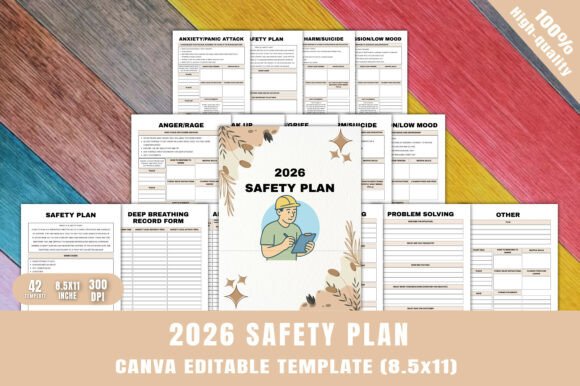
The 2026 Safety Plan is a fully customizable Canva template that includes 42 professionally designed pages. It goes beyond a simple calendar or journal by incorporating targeted sections for mental health tracking, crisis planning, and self-reflection. Pages cover anxiety, panic attacks, depression, low mood, self-harm, suicidal thoughts, loss and grief, breakups, anger and rage, and other concerns. There are also worksheets for problem solving, deep breathing, self-esteem, coping steps, goal setting, and annual goals, plus a doctor’s visit tracker, stress relief coloring pages, to-do lists, and notes pages.
What distinguishes this product is its combination of a 2026 monthly planner with a structured safety planning framework. You get both the forward-looking organization of a calendar and the reflective, preventive function of a safety plan. The template is editable in Canva, meaning you can change colors, fonts, layouts, and content to match your brand, personal style, or specific needs. The included files are high resolution and print ready, making the transition from digital design to physical product straightforward.
How It Compares With Other Safety Planning Approaches
Safety planning exists on a spectrum. On one end, you have clinical tools like the Stanley-Brown Safety Plan, often used by therapists and crisis services. These are structured but typically text-heavy and not designed for visual customization. On the other end, you have generic journals or bullet planners with no mental health focus. The 2026 Safety Plan sits somewhere in between: it offers clinical relevance through its topic-specific pages while remaining visually flexible and accessible to a broader audience.
Compared to creating a safety plan from scratch, this template saves considerable time. Instead of designing each page layout, considering section headers, or wondering what prompts to include, you receive a tested structure. You can then adapt the content to fit your own language, goals, or therapeutic framework. This is especially helpful for therapists, counselors, life coaches, or content creators who want to offer a professional-looking resource without spending hours on design.
Compared to a standard planner or bullet journal, the 2026 Safety Plan is more targeted. A typical planner helps you manage tasks and appointments but rarely includes guided prompts for emotional regulation, crisis prevention, or coping strategy documentation. This product fills that gap by integrating mental health support into a planning format, making it easier to check in with yourself regularly rather than only during moments of distress.
Strengths of the 2026 Safety Plan
- Customizability: Because it is a Canva template, you have full control over appearance. This is especially valuable if you want to match a brand identity, use specific colors that feel calming to you, or adjust fonts for readability.
- Comprehensive content: With 42 pages covering a wide range of mental health topics, this is not a single-purpose tool. It addresses multiple aspects of emotional well-being in one cohesive document.
- Print-ready and digital flexibility: You can use the template to create a physical book (perfect for KDP publishing or personal printing) or keep it digital for use on a tablet or device.
- Guided structure: For people who feel unsure where to start when creating a safety plan, the prompts and sections provide clear guidance without being overly prescriptive.
- Time savings: The design work is already done. You can focus on content and personalization rather than layout and formatting.
Tradeoffs and Limitations
No single tool works for everyone, and the 2026 Safety Plan has some tradeoffs worth considering. First, while the template is customizable, it does require a Canva account and basic familiarity with the platform. If you prefer working strictly in word processors or design software you already know, there may be a learning curve. Second, the product is a template, not a completed safety plan. It gives you the structure, but you still need to fill it with your own strategies, contacts, and goals. For someone looking for a pre-filled or clinical-grade safety plan, this may require more personal input than desired.
Another consideration is the scope of the topics. The template includes pages for anxiety, depression, grief, anger, and more, which is excellent for broad coverage. However, if your focus is narrowly on one area—for example, only self-harm prevention—you might find that many pages are less relevant. In that case, a more specialized resource could be a better fit. The flexibility of Canva does allow you to remove or reorder pages, but that adds extra steps if you are aiming for a streamlined document.
Additionally, while the 2026 monthly planner is integrated, the calendar elements are relatively simple. If you need a detailed daily planner with hourly scheduling, habit tracking, or project management, this template may not satisfy those needs on its own. It is designed as a supplementary planning tool for mental health, not a full-scale productivity system.
When the 2026 Safety Plan Is the Right Choice
This template is well suited for several situations. If you are a therapist, counselor, or coach looking for a resource to offer clients as a take-home tool, the professional design and comprehensive content make it a strong option. You can customize it with your branding and choose which pages to include based on each client's needs.
If you are someone who wants to take a proactive approach to your mental health in 2026, this product gives you a dedicated space to track moods, plan coping strategies, and set goals. The combination of a yearly overview with monthly planning and crisis-specific pages encourages regular reflection rather than reactive crisis management. For individuals who find open-ended journaling overwhelming, the guided prompts provide a helpful starting point.
Content creators and KDP publishers will also find this template valuable. The print-ready files and commercial-use compatibility (check the specific license terms) mean you can create and sell your own version of a safety plan journal with minimal design work. The 42-page count and variety of sections give you a product that feels substantial and useful.
When an Alternative Might Serve You Better
If you need a safety plan that is strictly clinical and aligned with a specific evidence-based protocol, you may prefer a tool like the Stanley-Brown Safety Plan template, which is free and widely used in healthcare settings. That format is briefer but more focused on crisis response. Similarly, if your main need is a detailed daily planner for productivity, a dedicated planner system might offer more calendar functionality.
If you prefer working with paper and pen without any digital design steps, purchasing a pre-printed safety plan journal could be more convenient than customizing a Canva template. There are several mental health journals on the market that bundle safety planning with guided journaling, though they typically offer less customization.
For someone with very specific or uncommon needs—such as safety planning for a child, for a specific phobia, or in a non-English language—the template's content may require significant adaptation. While Canva allows for text changes, you would need to rewrite many sections yourself. In that case, starting with a blank notebook or a fully customizable document editor might be equally efficient.
Decision Factors to Consider
When evaluating whether the 2026 Safety Plan aligns with your goals, consider the following:
- Your comfort with Canva: If you already use Canva or are willing to learn the basics, the template is easy to modify. If you dislike learning new software, factor in that time investment.
- Your primary use case: Personal mental health tracking, client resource, or commercial product? Each use case places different emphasis on customization, design polish, and content breadth.
- How much structure you want: The template provides substantial structure. If you prefer a completely blank slate, it may feel too guided. If you need help knowing what to include, it will feel supportive.
- Whether you need print or digital: The template works for both, but if you intend to use it digitally with interactive features (hyperlinks, fillable forms), you will need to set those up yourself in Canva or convert appropriately.
- Long-term use: The 2026 calendar means the planner component is year-specific. After 2026, you would need a new template or adapt this one by updating dates. The safety planning pages, however, remain useful beyond a single year.
Practical Examples of Use
Imagine you are a therapist who wants to provide a safety planning workbook to clients. You download the 2026 Safety Plan, open it in Canva, and customize the cover with your practice name and logo. You adjust the color scheme to match your brand and remove pages that are less relevant to your client population, such as the break-up page if you work primarily with anxiety disorders. You then export a PDF for each client, or print copies to hand out during sessions. The result is a professional, cohesive resource that supports your clinical work without requiring hours of layout design.
Consider a different scenario: You are an individual who experiences periodic low mood and anxiety, and you want to build a personal safety plan for the coming year. You use the template to map out your triggers, coping strategies, support network, and emergency contacts. You also use the monthly planner to schedule check-ins with yourself, and the goal-setting pages to track small wellness goals. The coloring pages become a calming activity during stressful moments. Over the year, the document evolves as you update what works and retire strategies that no longer serve you.
For a KDP publisher, the 2026 Safety Plan offers a ready-to-adapt interior. You can create multiple variations—one with a minimalist aesthetic, one with floral designs, one for teens—simply by changing the Canva theme. The included file specifications help ensure your upload meets Amazon’s formatting requirements, reducing the risk of rejection.
Making an Informed Decision
The 2026 Safety Plan is not a one-size-fits-all solution, but it fills a specific niche well. It combines the utility of a safety plan with the familiarity of a planner and the flexibility of a customizable Canva template. For people who value guided structure but also want creative control, it offers a practical middle ground. For those who need strict clinical fidelity or a highly specialized focus, other tools may be more appropriate.
Understanding what you need from a safety planning tool—whether it is clinical alignment, ease of use, branding flexibility, or comprehensive coverage—will guide you to the right fit. The 2026 Safety Plan works best when you want a ready-made framework that you can shape to your own context, saving time while still producing a result that feels personal and intentional.
If you are comfortable investing a few hours in customization, and if the range of included topics matches the areas you want to address, this template is a solid choice for building a safety plan that supports mental wellness throughout 2026 and beyond.