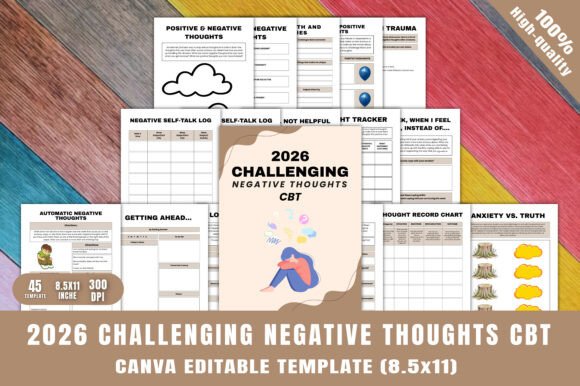
Reframing Your Mindset with the 2026 Challenging Negative Thoughts CBT Workbook
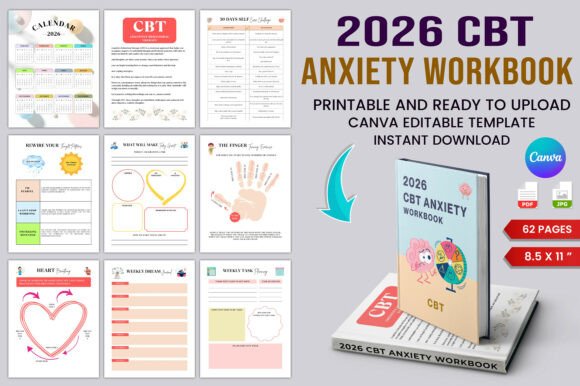
Cognitive Behavioral Therapy remains one of the most researched and effective approaches for managing negative thought patterns. The 2026 Challenging Negative Thoughts CBT workbook interior brings these evidence-based techniques into a structured, year-long format that supports both casual users and mental health professionals. By combining the proven ANT (Automatic Negative Thoughts) framework with practical tracking tools, this resource transforms abstract therapeutic concepts into daily actionable steps. The workbook is designed not just for reflection, but for measurable change across the entire year of 2026.
Understanding Automatic Negative Thoughts and the ANT Framework
Automatic Negative Thoughts, often abbreviated as ANTs, are the rapid, involuntary cognitive distortions that arise in response to everyday situations. These thoughts feel true in the moment but rarely hold up to objective examination. The 2026 CHALLENGING NEGATIVE THOUGHTS CBT workbook dedicates significant space to identifying these mental patterns through dedicated ANT worksheets. Users learn to recognize common distortion categories—such as all-or-nothing thinking, catastrophizing, and emotional reasoning—before moving on to structured reframing exercises.
What distinguishes this workbook from simpler journals is its layered approach. Each ANT identification page pairs with a corresponding untwisting exercise, guiding the user through the five-step process of recognizing, recording, questioning, reframing, and reinforcing healthier perspectives. This method mirrors what happens in a therapist’s office but adapts it for independent, daily use. For educators and researchers studying cognitive interventions, the workbook offers a replicable structure that can be adapted for group settings or clinical studies.
The Psychology Behind Untwisting Your Thinking
Cognitive distortions are called “twisted” thinking because they bend reality toward negativity. The untwisting process taught in 2026 Challenging Negative Thoughts – CBT relies on cognitive restructuring, a core CBT technique. Users are prompted to act as detectives, examining the evidence for and against their troubling thoughts. This detective work is not about forced positivity; it is about accuracy. A page titled “Be a Detective” encourages users to ask: What is the actual evidence? Is there a more balanced way to see this? What would I tell a friend in the same situation?
By repeatedly practicing this investigation, the brain gradually builds new neural pathways. The workbook’s monthly planner from January to December ensures that these exercises are not abandoned after a few weeks. Each month revisits core concepts with fresh prompts, preventing the repetition fatigue common in other self-help resources. The weekly anxiety tracker, titled “This Week, When I Feel Anxious, Instead Of…,” provides a concrete alternative behavior plan, linking thought patterns directly to actionable coping strategies.
Year-Round Planning Meets Therapeutic Structure
One of the standout features of this workbook interior is the integration of a full 2026 calendar and monthly planner alongside the therapeutic content. This combination serves a dual purpose. First, it grounds the cognitive work in real-life scheduling. Users can link specific negative thought patterns to actual events—work deadlines, family gatherings, health appointments—allowing for pattern recognition across contexts. Second, the planner format encourages consistent engagement. When journaling becomes part of a weekly planning routine, it is far more likely to stick than a standalone exercise book left on a shelf.
Business owners and creators who purchase the Canva KDP interior can appreciate how this dual functionality increases the product’s market appeal. A consumer looking for a planner may discover the CBT elements as a bonus, while someone seeking mental health support gains organizational structure. This crossover utility is a deliberate design choice that makes the workbook suitable for a broad audience. The editable Canva template allows further customization—colors, fonts, and even additional prompts can be tailored for specific niches such as teen mental health, corporate wellness programs, or university counseling centers.
Strengths Identification as a Foundation for Resilience
The “My Strengths and Qualities” page is strategically placed early in the workbook, before users dive into heavy cognitive restructuring. This ordering is intentional. Research in positive psychology shows that acknowledging personal strengths builds psychological resilience, making it easier to confront negative patterns later. The exercise asks users to list traits they value in themselves, accomplishments they are proud of, and compliments they have received. For individuals coping with trauma or chronic low self-esteem, this page can be revisited whenever the thought record sections feel overwhelming.
The workbook does not treat trauma as a separate, isolated topic. Instead, the “Coping with Trauma” spread is woven into the broader narrative of cognitive reframing. It acknowledges that trauma responses often manifest as extreme automatic thoughts—hypervigilance, self-blame, or fear of recurrence. The exercises here guide users to differentiate between past danger signals and present safety cues, a technique grounded in trauma-informed CBT. This nuanced inclusion makes the interior suitable for therapists who work with trauma survivors and want a structured yet gentle tool for homework assignments.
Practical Tools for Thought Tracking and Self-Talk Reframing
The heart of the 2026 CHALLENGING NEGATIVE THOUGHTS CBT workbook lies in its tracking systems. The “Thought Tracker” provides a grid where users log the date, triggering situation, automatic thought, emotional response, and a reframed perspective. Over weeks, this tracker reveals patterns—perhaps certain times of day or specific people consistently trigger negative spirals. The “Positive Negative Thoughts” page offers a side-by-side comparison exercise, forcing users to articulate both the negative interpretation and a plausible positive or neutral alternative.
You will also find dedicated logs for positive and negative self-talk. These logs are separate because the brain processes praise and criticism differently. The negative self-talk log helps users catch harsh internal commentary they might otherwise overlook. Meanwhile, the positive self-talk log builds a repository of affirming statements that can be accessed during difficult moments. This dual-log approach acknowledges that combating negativity requires both reducing harmful speech and increasing supportive speech. Researchers studying self-compassion interventions will find this structure particularly useful for data collection in longitudinal studies.
The Anxiety vs. Truth Thought Record Chart
One of the most clinically valuable pages is the “Anxiety vs. Truth” chart. This exercise asks users to write down an anxious thought in one column and then, in the adjacent column, state what is objectively true about the situation. For example, an anxious thought might be “I will fail this presentation and everyone will judge me.” The truth column might read “I have prepared thoroughly, I have delivered successful presentations before, and most people are focused on themselves, not on me.” This simple act of separation weakens the grip of anxiety by exposing the gap between fear and reality.
The chart works well alongside the “Positive Self-Talk Log” and the “Negative Self-Talk Log.” When users notice a pattern of anxious predictions, they can trace the associated self-talk and identify whether it leans helpful or harmful. For creators customizing this interior, adding a section for physical anxiety symptoms—racing heart, shallow breathing—could further enhance the mind-body connection. Educators can use the chart as a classroom activity to teach adolescents how to challenge social anxiety, while coaches might incorporate it into performance mindset training.
Customization Potential for Creators and Professionals
The 2026 Challenging Negative Thoughts – CBT Canva KDP Interior is delivered as an editable Canva template alongside print-ready PDF, high-resolution JPG, and PNG files. This multi-format approach addresses different workflows. The Canva link allows drag-and-drop customization—ideal for those who want to rebrand the workbook for their own audience or add niche-specific prompts. The print-ready PDF serves users who need a no-fuss, professional-grade file for print-on-demand platforms like Amazon KDP. The JPG and PNG files are suitable for digital planners used in apps like GoodNotes or Notability.
With 33 unique pages, the interior covers more ground than typical CBT journals. The inclusion of a 2026 calendar and monthly planner from January to December ensures year-long usability, which directly impacts customer satisfaction and reviews. For business owners, this means a product that sells in December as a New Year’s resolution tool and remains relevant through the following November. The editable nature also means you can update the calendar year without redesigning the entire workbook, creating a scalable product line for 2027, 2028, and beyond.
Who Benefits Most from This Workbook Format
While the workbook is accessible to anyone, certain user groups will find it especially valuable. Individuals new to CBT benefit from the guided, step-by-step structure that requires no prior therapeutic knowledge. Mental health professionals can assign specific pages as between-session homework, tracking client progress through the thought records and self-talk logs. Educators in psychology or social work programs can use the workbook as a teaching tool, demonstrating how theoretical CBT concepts translate into practice. Hobbyists interested in personal development will appreciate the creative layout and the satisfying rhythm of weekly check-ins.
Researchers studying the effectiveness of self-guided CBT interventions could use the workbook as a standardized instrument across study participants. Its consistent structure—with the same exercises repeated monthly—allows for pre- and post-intervention comparisons. The strengths identification and coping with trauma sections add depth that many generic workbooks lack. For business owners in the self-help niche, this interior offers a ready-made product that requires only branding and cover design before publication, significantly reducing time to market.
Considerations for Effective Use and Customization
To get the most out of the 2026 CHALLENGING NEGATIVE THOUGHTS CBT workbook, consistency matters more than intensity. The monthly planner encourages daily or weekly engagement rather than marathon sessions. Users should start with the ANT identification pages before moving to the untwisting exercises, as the order builds skill progressively. For those who find the thought record chart overwhelming, beginning with the “Positive Self-Talk Log” can be a gentler entry point. The workbook is designed to be flexible—skip pages that do not resonate and return to them later.
When customizing the Canva template, consider your audience’s reading level and cultural context. The language in the original interior is straightforward but clinical terms like “automatic thoughts” and “cognitive distortions” may need brief definitions for general consumers. Adding a glossary page or tooltip-style footnotes can increase accessibility. Color choices also matter: soft blues and greens are calming, while warm oranges and yellows can energize. If targeting a corporate wellness program, neutral tones with clean typography will feel more professional. For teens, brighter colors and modern fonts can improve engagement.
Another consideration is the balance between digital and print use. The high-resolution JPG and PNG files are ideal for digital planners where users can type responses or use a stylus. However, research suggests that handwriting thoughts deepens cognitive processing, so the print-ready PDF may yield stronger therapeutic outcomes. Offering both options within the same product listing—as this interior does—caters to different preferences without compromising quality. For KDP publishers, including a note about recommended paper weight (at least 90 GSM to prevent bleed-through) can reduce returns and negative reviews.
Real-World Applications Across Settings
Imagine a busy professional who starts each Monday by reviewing the previous week’s thought record. They notice a pattern: every Sunday evening, anticipatory anxiety about Monday meetings triggers negative self-talk. Using the “This Week, When I Feel Anxious, Instead Of…” page, they schedule a 10-minute Sunday night planning session to review the agenda and prepare talking points. Over three months, the Sunday anxiety diminishes as the brain learns that preparation reduces uncertainty. This is the workbook in action—turning insight into behavioral change.
In a classroom, a high school counselor might use the “Automatic Negative Thoughts” page as a group activity. Students share examples of thoughts like “I’m the only one who didn’t understand the lesson” and discover how common these distortions are. The counselor then guides them through the detective exercise, normalizing the experience and building collective resilience. For researchers, the same workbook could be distributed to two groups—one using the full workbook and one using only the thought tracker—to measure which components drive the most significant reduction in anxiety scores.
The 2026 CHALLENGING NEGATIVE THOUGHTS CBT workbook interior succeeds because it respects the complexity of cognitive change while providing a simple, repeatable structure. It does not promise instant transformation but offers a year-long companion for gradual, evidence-based growth. Whether used independently, in a clinical setting, or adapted for a broader audience, its 33 pages contain the core tools of cognitive behavioral therapy in a format that is both practical and deeply human.