Editable 500 Shadow Work Journal Prompts: A Deep Dive into Inner Healing
Shadow work is not a passing trend. It is one of the most transformative practices for anyone committed to genuine personal growth. The concept, rooted in Carl Jung’s analytical psychology, involves bringing unconscious aspects of your personality into conscious awareness. These hidden parts—the fears, resentments, shame, and suppressed desires—often dictate your behavior, relationships, and self-worth without you even realizing it. The Editable 500 Shadow Work Journal Prompts offers a structured yet flexible path into this inner territory. Instead of staring at a blank page wondering where to start, you get 500 carefully crafted questions that gently guide you toward the shadows you may have been avoiding.
Why Shadow Work Matters for Modern Life
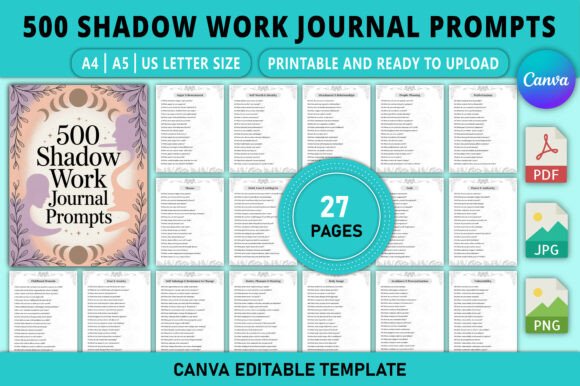
Many people spend years trying to fix surface-level problems. They address procrastination without examining the fear of failure underneath. They work on people-pleasing without exploring the deep belief that their worth depends on others’ approval. Shadow work cuts through this cycle. By engaging with prompts on topics like childhood wounds, shame, control, and emotional suppression, you begin to see the roots of your patterns. The Editable 500 Shadow Work Journal Prompts covers 24 core themes, including fear and anxiety, anger and resentment, perfectionism, guilt, jealousy and envy, body image, money scarcity, and self-sabotage. Each theme is designed to peel back a layer, helping you understand not just what you feel, but why you feel it.
For therapists, coaches, and individuals on a healing journey, this breadth is invaluable. You do not need to search for scattered resources or invent your own questions. The journal organizes the work into logical categories, allowing you to focus on one area at a time or move intuitively between them. This structure mirrors what happens in effective therapy sessions: you explore a theme until it loses its power over you, then move to the next.
What Makes These Prompts Different
There is no shortage of journal prompts online. But the Editable 500 Shadow Work Journal Prompts stands out for several reasons. First, the volume. With 500 prompts, you have enough material for daily reflection over many months. Shadow work is not a quick fix. It requires repetition, revisiting old wounds from new angles, and sitting with discomfort until integration occurs. A smaller set of prompts might exhaust its usefulness after a few weeks. This collection sustains a long-term practice.
Second, the prompts are not generic. They are specific enough to provoke real introspection. For example, under the theme of childhood wounds, you might encounter prompts that ask about the messages you internalized from caregivers, the moments you felt unseen, or the ways you learned to earn love. Under the theme of control, the prompts explore not just your need for control but what you fear would happen if you let go. This specificity is what turns journaling from a surface-level activity into a genuine therapeutic tool.
A Tool for Therapists and Self-Guided Work
Whether you are a mental health professional looking for structured resources for clients or an individual committed to self-reflection, the journal adapts. Therapists can assign specific prompt categories that align with a client’s current work. For example, someone dealing with chronic anxiety might start with the fear and anxiety section before moving into self-worth and identity. The prompts are neutral enough to be used across different therapeutic modalities, but deep enough to uncover meaningful material.
For self-guided users, the journal offers a safe container. You do not need a facilitator or guide. The prompts themselves become your mirror. They ask the questions a skilled therapist might ask, but you answer them in your own time, at your own pace, without judgment. This autonomy is empowering. It reinforces the idea that you already have the answers inside you; you just need the right questions to access them.
Full Customization in Canva
One of the most practical features of this product is that it is fully editable in Canva. You can change the text, fonts, colors, and layout to match your personal style or brand. This is especially useful for therapists, coaches, and content creators who want to offer a cohesive experience to their clients or audience. If you run a wellness blog, an Etsy shop, or a coaching practice, you can rebrand the journal as your own, adding your logo and preferred color palette.
The ability to edit also means you can adapt the prompts to your specific needs. Maybe you want to rephrase a question to resonate more with a particular demographic. Maybe you want to combine prompts from different categories into a custom workbook. The Editable 500 Shadow Work Journal Prompts gives you that flexibility. You are not locked into a rigid PDF. You have a living document that evolves with your practice.
Multiple Print Sizes for Every Use
The journal is available in three standard sizes: A4 (8.26” x 11.69”), A5 (5.8” x 8.3”), and US Letter (8.5” x 11”). This variety ensures that whether you prefer a compact journal for carrying in your bag or a larger format for detailed writing, there is an option that fits. The A5 size is particularly popular for daily carry, while US Letter and A4 work well for binder use or at-home journaling sessions. Having multiple sizes also makes the product suitable for different printing setups, whether you use a home printer, a local print shop, or an online service.
For digital use, the Canva template allows you to use the journal on a tablet with apps like GoodNotes, Notability, or Noteshelf. Many people prefer digital journaling because it is searchable, easy to organize, and environmentally friendly. The Editable 500 Shadow Work Journal Prompts supports both analog and digital workflows seamlessly.
Navigating the Core Themes
The journal covers 24 distinct themes, each addressing a critical area of the human experience. Let’s explore a few of them to understand the depth you can expect.
Childhood Wounds and Identity
This section delves into the formative experiences that shaped your sense of self. Prompts here ask about the unmet needs of your younger self, the roles you played in your family system, and the beliefs you formed about love, safety, and belonging. Understanding these roots is essential because most adult struggles can be traced back to childhood adaptations that no longer serve you.
Fear, Anxiety, and Emotional Suppression
These themes are closely linked. The prompts guide you to identify the specific fears that drive your anxiety, the ways you have learned to numb or suppress emotions, and what it might feel like to allow those emotions to surface safely. Emotional suppression is often a survival strategy, but it comes at a high cost. This section helps you gently dismantle that defense.
People-Pleasing, Perfectionism, and Guilt
These three themes often form a triad. People-pleasing stems from a fear of rejection, perfectionism from a fear of inadequacy, and guilt from a belief that you are inherently wrong or burdensome. The prompts in these categories are designed to untangle these knots. You will explore what you gain from these patterns, what you lose, and who you might be without them.
Boundaries, Vulnerability, and Trust
Healthy boundaries require vulnerability, and vulnerability requires trust. If you struggle with any of these, the prompts offer a safe way to practice. You will examine past experiences where boundaries were violated, moments when being vulnerable led to pain, and the beliefs you now hold about trust. This section is particularly helpful for anyone working on relational healing.
Self-Sabotage and Resistance to Change
Self-sabotage is often misunderstood as laziness or lack of willpower. In reality, it is a protection mechanism. The prompts in this area help you uncover the unconscious payoff of staying stuck. What does your self-sabotage protect you from? Failure? Success? Judgment? Change itself? By bringing these dynamics into awareness, you can start to make conscious choices instead of repeating old patterns.
Practical Considerations Before You Start
Shadow work is powerful, and it can also be intense. Before diving into the Editable 500 Shadow Work Journal Prompts, consider a few things. First, pace yourself. You do not need to answer all 500 prompts in a week. Try one prompt per day, or three per week. Allow yourself time to sit with each answer. The goal is not completion but integration.
Second, create a supportive environment. Have a tissue box nearby. Play soft music. Light a candle. Whatever helps you feel safe. Some prompts may bring up tears, anger, or discomfort. That is normal and even desirable. It means you are touching something real. If you feel overwhelmed, take a break. You can always return to the same prompt later.
Third, consider pairing the journal with therapy or coaching. While the prompts are designed for self-guided work, having a professional to process difficult material can be invaluable. The journal can also serve as a bridge between sessions, helping you articulate what you want to bring to your therapist.
Who Benefits Most from This Journal
The Editable 500 Shadow Work Journal Prompts is suitable for a wide audience. If you are someone who has done personal development work before and feels ready to go deeper, this journal will meet you there. If you are new to shadow work, the prompts are gentle enough to start without feeling overwhelmed, but deep enough to sustain long-term practice.
Therapists and coaches will appreciate the editable format. You can create customized workbooks for clients, add your own prompts, or rearrange the categories to fit a specific curriculum. Content creators in the wellness space can use the journal as a lead magnet, a product in their shop, or a resource in their courses. The commercial flexibility is significant.
For anyone struggling with recurring patterns in relationships, career, or self-esteem, this journal offers a structured way to investigate the root causes. It is not a magic cure, but it is a reliable tool. The work of healing happens in the small, consistent moments of turning inward. Having 500 prompts ensures that those moments never run dry.
Final Thoughts on Shadow Work and Sustainable Growth
Healing is not linear. Some weeks you will feel breakthroughs. Other weeks you will feel resistance. The Editable 500 Shadow Work Journal Prompts accommodates both. You can skip a prompt, return to an earlier one, or spend a whole month on a single theme. The flexibility of the editable format supports this organic process. Whether you print it, use it digitally, or rebrand it for your practice, the core value remains: a comprehensive, compassionate invitation to know yourself more fully.
If you have been looking for a way to begin or deepen your shadow work practice, this journal removes the friction of creating your own prompts from scratch. It hands you a map. Your job is simply to walk the terrain, one prompt at a time. The shadows you uncover are not enemies. They are parts of you waiting to be understood, integrated, and finally, freed.