1200 Shopify Branding Ideas: A Practical Workflow for Brand Development
Building a Shopify store is straightforward. Building a brand that customers remember and trust is a different challenge entirely. Many store owners start with a product, a logo, and a theme, then wonder why their store feels generic. The missing piece is often a structured process for generating and refining brand ideas before committing to a visual identity. The 1200 Shopify Branding Ideas workbook offers a systematic way to approach this phase, moving from vague concepts to specific, actionable directions. This article covers how to integrate this resource into your actual workflow, from initial brainstorming through final implementation and long-term consistency.
Where the Workbook Fits in Your Brand Development Process
The workbook is not a design tool. It does not create logos or pick fonts. Instead, it functions as a structured foundry for raw brand concepts. You can use it at several points in your workflow:
- Before you start building: When you have a product idea but no clear brand direction, the workbook helps you explore positioning, themes, and identity angles across dozens of niches. This prevents the common mistake of designing a store around a product rather than a brand.
- During a creative block: If you have a half-finished store but feel the brand identity is flat or derivative, the workbook can inject fresh angles without requiring a complete restart. You can scan relevant sections and remix ideas into your existing framework.
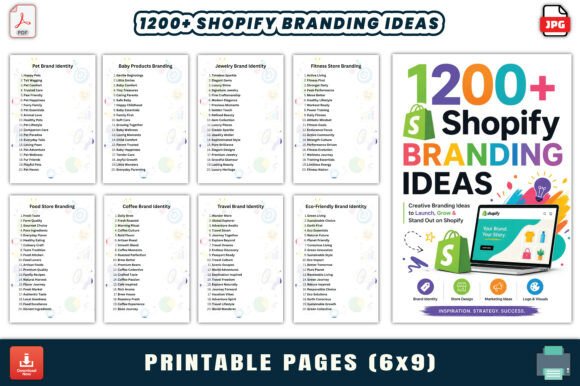
- After launch, for iteration: Established stores sometimes need to refresh their image, expand into new product lines, or target a different audience. The workbook’s breadth (62 pages across 20+ niches) provides material for repositioning without starting from scratch.
- As a validation tool: Before investing in design assets or marketing, you can use the workbook to pressure-test your brand idea against alternative directions. Seeing multiple positioning options side by side helps you assess which one has the strongest foundation for your specific products and audience.
This timing flexibility makes the resource useful for freelancers, agencies building multiple client stores, and solo entrepreneurs managing one project at a time.
Structuring Your Ideation Session Around the Workbook
To get the most out of the 1200 Shopify Branding Ideas workbook, treat each session as a focused project phase rather than casual browsing. Here is a practical workflow you can follow:
- Define your product and audience first. Before opening the PDF, write a one-paragraph description of what you are selling and who you are selling to. This creates a filter for the ideas you will review.
- Skim the workbook by niche. The workbook organizes ideas by categories such as Fashion, Beauty, Technology, Home Decor, Pets, Fitness, Jewelry, Baby Products, Outdoor Camping, Food & Beverage, Eco-Friendly Brands, Travel, Coffee, Gaming, Luxury Products, Handmade Goods, Digital Products, Sports, Kids Products, and Stationery. Start with your primary niche, but also scan adjacent categories. A pet store might find useful positioning ideas in the Baby Products or Eco-Friendly Brands sections.
- Capture raw concepts without editing. As you review each page, jot down words, phrases, or concepts that spark a reaction. Do not judge or filter yet. The goal is to generate 20–30 potential brand directions in one session.
- Cluster and refine. After the initial capture, group related ideas. For example, if you have multiple ideas around minimalism, luxury, and handcrafted quality, those might form different brand archetypes. Use the clustering to narrow down to two or three strong directions.
- Test against your audience and product. Take your shortlisted directions and write a brief brand positioning statement for each. Does it resonate with your target audience? Does it differentiate you from competitors? The workbook provides raw material, but your own judgment about fit is what transforms those ideas into usable concepts.
This structured session works whether you use the print-ready PDF on paper or the JPG/PNG files on a tablet. The physical act of marking pages or taking notes on a separate document helps commit the ideas to memory and makes the session feel like real work rather than passive inspiration.
Integrating Workbook Ideas with Other Brand Assets
The workbook excels as a starting point, but the ideas it generates need to connect with your actual design and content process. Here is how you can bridge the gap between a conceptual direction and a functional brand identity:
- Logo and color palette: Once you have a direction (e.g., “sustainable outdoor gear with a vintage aesthetic”), use that as a brief for a designer. The workbook ideas provide the tone and positioning, which makes the design brief concrete instead of abstract.
- Visual identity and typography: The workbook’s categories often imply a visual language. A “Luxury Products” direction will demand different typefaces and imagery than a “Kids Products” direction. Use the chosen concept to select fonts, photography style, and iconography that reinforce the same positioning.
- Product descriptions and copy: The brand ideas in the workbook often suggest a voice and tone. An eco-friendly brand might use language around responsibility, natural materials, and longevity. A gaming brand might lean into energy, community, and innovation. Align your copywriting with the chosen positioning to maintain consistency.
- Social media and content strategy: The workbook can also inform the type of content you create. A travel brand might focus on storytelling and destination imagery, while a technology brand might emphasize problem-solving and functionality. The positioning ideas naturally suggest content themes.
This integration step is where the workbook moves from an inspirational resource to a practical tool that directly shapes your store’s identity across every touchpoint.
Quality Control and Consistency Across Your Store
One risk of using a large idea collection is ending up with a hodgepodge of concepts that do not hang together. To maintain quality and consistency, build simple checkpoints into your process:
- Create a brand brief document. Write down the core direction you selected from the workbook, along with key attributes, audience, and tone. Refer to this brief whenever you add new products, design a page, or create marketing assets.
- Review all decisions against the brief. Before finalizing a logo concept, color palette, or homepage layout, ask: “Does this align with the brand direction we chose from the workbook?” If the answer is no, you either need to adjust the decision or revisit whether your direction is correct.
- Plan for long-term use. The workbook contains 62 pages, but you do not need to use all the ideas at once. As your store grows, you might revisit the workbook to evolve the brand for new product lines or seasonal campaigns. Keep your original notes and brief so you can expand consistently without contradicting the initial positioning.
Consistency is what turns a collection of products into a recognized brand. The workbook helps you generate the raw material, but you are responsible for maintaining the discipline of applying it coherently.
Practical Implementation Tips for Different Niches
The value of the workbook varies by niche, but here are a few observations based on common workflows:
- Fashion, Beauty, Jewelry, Luxury: These niches rely heavily on visual identity and emotional positioning. Use the workbook to define the aspirational tone early. Spend extra time on the clustering step to ensure the brand direction feels cohesive across product photography, packaging, and social media.
- Eco-Friendly, Handmade, Food & Beverage: Storytelling is often central here. The workbook’s ideas around values, process, and community can directly inform your “About” page, product descriptions, and content strategy. Print the relevant pages and use them as a brainstorming guide for copywriting sessions.
- Technology, Gaming, Digital Products: Precision and innovation are key. The workbook can help you position a technical product as approachable or cutting-edge. Focus on clarity and differentiation, avoiding vague or overly broad ideas that might not resonate with a tech-savvy audience.
- Pet, Baby, Kids, Outdoor, Travel, Coffee, Sports: These niches often have passionate, loyal audiences. Use the workbook to explore lifestyle angles that connect with how customers see themselves. For example, a pet brand could lean into adventure, health, or companionship depending on the audience segment.
- Home Decor, Stationery: Aesthetic curation matters most. The workbook ideas can help you pick a consistent theme that ties different product types together, reducing the risk of a store that looks like a random collection of items.
In each case, the workbook is a tool for focusing your creative energy, not a substitute for market research or design skill. Use it to generate options, then validate those options against your specific market conditions and customer expectations.
The 1200 Shopify Branding Ideas workbook is a resource designed for the planning and execution phase of store building. When used deliberately, it saves time, reduces creative friction, and produces brand directions that are both original and practical. The real work happens after you have chosen a direction, but having a structured source of raw concepts makes that work more efficient and less speculative. By integrating the workbook into your regular brand development process, you can build stores that feel intentional, consistent, and relevant to the audiences you serve.